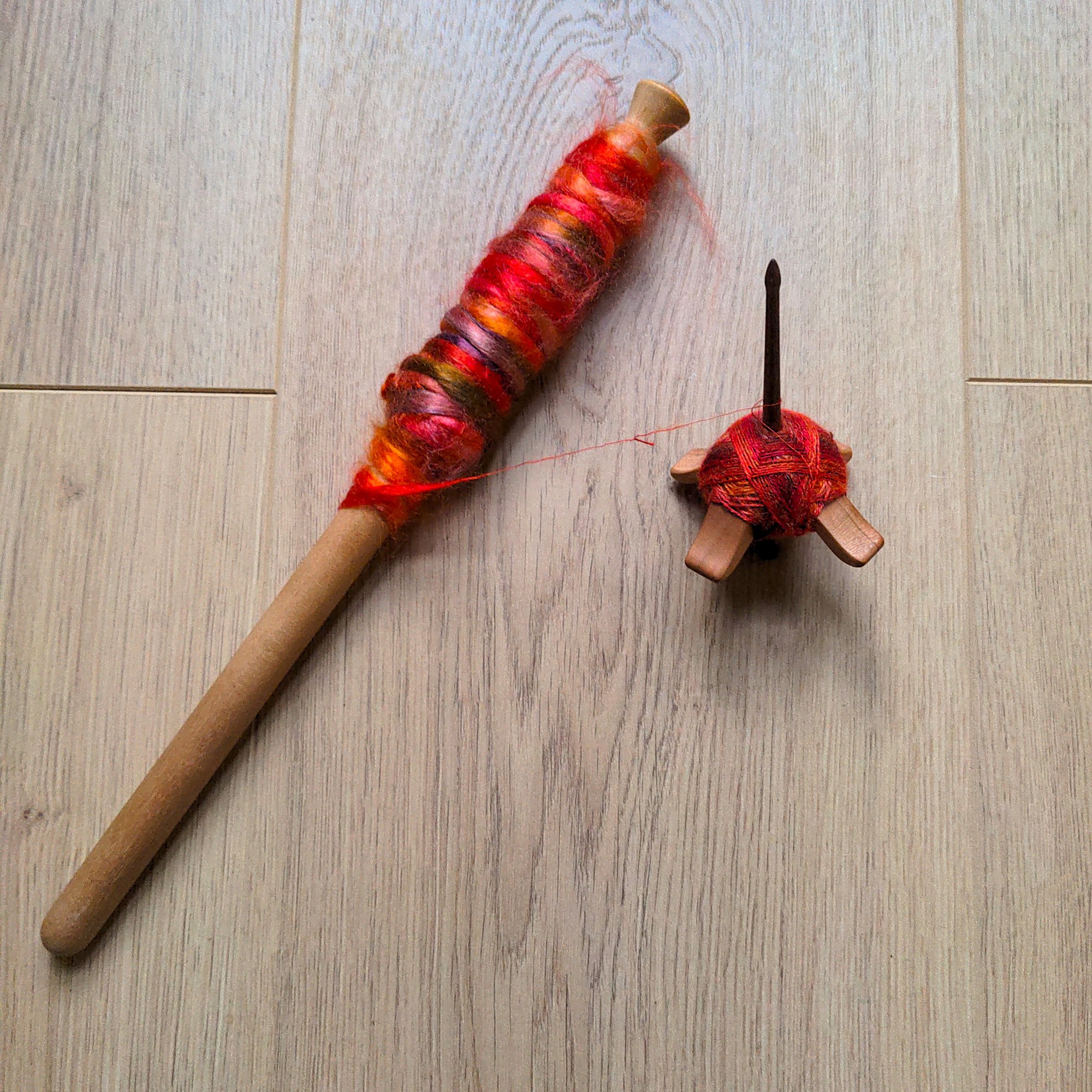
Nu ik een katoen monster heb gesponnen op mijn kleine, kleine Turkse spintol, was het tijd om verder te oefenen, maar nu met viscose.
Met het spinnen van het katoen was ik er al achter gekomen dat in plaats van de vezels in mijn hand te houden het voor mij beter werkt om de vezels eerst op een spinrok te winden. Voordat ik dit deed met de viscose had ik eerst de lont meerdere keren gesplitst.
Achteraf gezien was dit misschien niet een goed idee. Het splijten veroorzaakte namelijk veel pluizigheid dat ook in de gesponnen draad terug te zien is. De bedoeling is juist om een zo glad mogelijk draad te spinnen, want hoe gladder de draad hoe beter het wil frivliteeën.
Een gespleten lont betekende ook dat ik meerdere uiteinden wel in de hand moest vasthouden, en dat resulteerde duidelijk in een onregelmatiger draad.
Het katoenen had duidelijk te weinig twist om de spanning die frivolité veroorzaakt te weerstaan. Viscose heeft langere vezels en heeft dus minder twist nodig, maar het leek mij toch heel verstandig om extra twist aan te brengen. Dit deed ik door, wanneer de enkele gesponnen draad de volle lengte had bereikt, voor ik het weer op ging winden, de spintol nog 2 keer aan het spinnen bracht.
Ok, ok, voor ik het op wond ging ik dat deel eerst ketting twijnen. Dit afwisselen van spinnen en twijnen heet in het Engels “ply on the fly” en ik vind het een zeer prettige methode om garen te maken met een Turkse spintol, zeker als het gaat om dun draad.
Naar mijn mening heb ik zo meer controle en krijg ik minder breuken en minder kans op in de knoop geraakte enkele draad.
Ik ben ervan overtuigd dat dit garen wel sterk genoeg is om mee te frivoliteeën, maar of de dikte gelijk genoeg is dat het leuk is om dat mee te doen, moet nog blijken. Een zo gelijk mogelijke dikte krijgen is nu ook waar ik me met de rest van dit spin project het meest op focus.
English
Spinning viscose thread
Having practiced spinning a cotton sample on my tiny cross armed spindle, it was now time to try out viscose.
I’d already figured out with the cotton that having the fibre on a handheld distaff works better for me than holding a piece of combed top in my hand. So, after having split the combed viscose top several times I wound it piece by piece on the hand held distaff.
The splitting was probably not the best idea. It split rather fuzzily, and the fuzz also came in the resulting thread, while the goal is to have it as smooth as possible.
It also means there are several end bits that I do need to hold in my hand, which results in a less consistent thread.
Next time I’ll see how it goes without splitting the top.
The cotton sample needed way more twist to withstand the strain that tatting puts on thread. So even though viscose has longer fibers than cotton, I made sure that it did get more twist by giving the spindle 2 extra flicks every time when the single had reached the desired length before winding on.
“Before winding on” is not entirely correct because first I chain plied that bit, and then wound it on. This method of alternating spinning and plying is called ‘ply on the fly’, and I really, really like this method with cross armed spindles, even more so when creating thread.
To me it feels like I have more controll of the singles, plus very possibly less chance of breakage and thread barf.
I’m sure this thread will be strong enough to tat with, but there’s a high chance that the thickness inconsistency is taking out all the fun.
Getting the thread singles of a more consistent thickness is the main focus with the rest of this spin.
Maybe I’m wrong and it is already consistent enough, but better consistency can only improve the enjoyment of tatting with it.
1 Comment
[…] is gelukt!Ik kan frivoliteeën met mijn eigen handgesponnen draad!In het vorige bericht dat ik hierover schreef had ik al vermeld dat het spiltsen van de lont achteraf gezien niet het […]